Tuesday, July 2, 2019

Ch-ch-ch-ch-changes!

"Oh, look out you rock 'n rollers. Pretty soon now you're gonna get older..." https://www.youtube.com/watch?v=pl3vxEudif8  
The David Bowie song I reference in my title came out in the ’70’s: “Time may change me,/But I can’t trace time.” —Words that take on a completely different meaning when you consider them from different perspectives! My mind goes there today because I have so many things changing in my own life right now...so many, in fact, that it took me this long to put up another post, as I am doing today.


Last thing I mentioned, back in February, had to do with my cousin Bill’s discoveries and research into the Alewine name, and the whole DNA thing again. From the very first, back in 2017, my intention for this blog was just to put out the records I have, as many documents and pictures as I could scan, and let relatives add to the story if they knew other things; and Bill stepped in and contributed to our benefit. So far there’s been a limit to how far back some lines can be traced, on any side, for reasons everybody knows:

...People moved around a lot more than we might think they did.


...There were no copy or fax machines, computers, phones…and, more to the point, many of our ancestors weren’t all that great at writing.


...And my favorite: Paper burns.


The last one accounts for a good many dead-ends when people begin to draw out their family trees. I can’t tell you how many times I’ve heard, “Well, that courthouse burned down in 1880—” or some other year, making it nearly impossible to get certain documents I needed from a specific time.


I have about 5 boxes still of Alton Alawine’s papers which he left to me. Most are yellowing notebook scraps, scribbled in his tiny script. They are, in some cases—depressingly—repeats and repeats. I would be happy to trade them for a few really detailed journals of a couple of family lines—but such things don’t exist. William Bradford, the early governor in Massachusetts who kept excruciatingly detailed records in History of Plymouth Plantation, is remembered because he was an exception. Most people were just surviving and didn’t write daily descriptions of their and their neighbors’ lives.


So I again invite any descendants to add to the information I’ve been trying to make available, if you have documents and so on. I’ve attempted to shed any light I can on the Skinner, Mercer, Richards, and Wells lines. On my mother’s side, in other posts, I wrote about the Culbertsons, Claughtons, and Tolberts.


Today it will be the Lukes.
Except for the Claughtons, most of Cecile Tolbert’s ancestors had come early into Mississippi and remained here through several generations, as previous posts have shown. And the same seems to be true of the Lukes. They eventually settled around the Kemper County/Neshoba County area and more or less stayed there. A document prepared years ago by a Luke descendant in Kemper County indicates the basic line.
 
I’m not sure that every single detail in this document is accurate, but I find one thing interesting because it confirms a detail even my father (not related to the Lukes except through his wife Cecile, my mother) knew about her grandfather: Lon (Alanzo), who was born in 1874 in Mississippi, was deeply interested in the Choctaw culture and had friends among the Tribe who'd come by his farm from time to time and stay for a few days to work. Sometimes, according to Mother, Lon would go off on "rambles" with them, to places unknown, returning in a few days. 

Below is a copy of the record of his WWI registration. I'm including it because it has his birthday.
It wasn’t very hard to trace Cecile’s mother, Lillian Luke, back to James M. Luke, for the reason I mention above: the family had been in Mississippi since the 1830’s-40’s. Below are census records from 1860 onward:
1860 Kemper Co., MS
About halfway down the one above, you see James Luke and his children.
1880 Kemper Co. MS
As luck has it, all these census sheets have the Lukes toward the middle, so I'm including the whole page. Above, you see John Luke and his children, including Alanzo. In the next censuses Alanzo (or "Lon") shows up with his wife Rosa. In the 1900 one, the family list continues onto another page, and there are other Luke families shown on these following records.
1900 Kemper Co MS page 1
1900 Kemper Co. MS page 2

1910 Kemper Co. MS
1920 Kemper Co. MS
1930 Neshoba Co. MS
I haven’t been able to find pictures of other Lukes, going back past Alanzo, but here again is a photo of him and his wife Rosa Claughton.
Rosa Claughton Luke and Alanzo "Lon" Luke ca 193o's

Next post: a strange story from my own childhood, and a feeling that all things are kind of connected.

Ælfwine
 

Saturday, February 16, 2019

What's in a Name? Part Two

It’s been a while.

I’ve been deeply involved in another project, and then, SCHOOL, of course—a new schedule with one more class per day added, new requirements for lessons, and so on. I’ll be honest, though: When I could have done posts on the weekend, I was busy with the project instead. I try to leave school at school.


In the meantime, however, I’m happy to have made the acquaintance of a distant cousin in Virginia, Bill Alewine, who has some additional information on John (or Johan) George Alewine that he’s graciously told me to pass on. We talked on the phone as I scribbled notes—and “scribbled” is an understatement—so, Bill, if this is inaccurate, do let me know.

Below is a chart he put together for me, to show how his side of the family meshes with “ours.” But if you look all the way to the top, you’ll see our common ancestor who arrived in the United States. Some of this information appeared in one of Alton Alawine’s last documents before his vision deteriorated to the extent that he couldn’t write anymore, but this new chart clarifies the lineage.

I’d known about the ship, and I had the documents showing the Mary Reissinger connection. Mary was John George’s son Michael’s wife; the John in these documents is their son, who married Katharine (“Caty”), and the documents describe a land sale by Mary, John, and Caty to Allen de Graffenreidt. With Bill’s permission, I’m including his scans because they are better than mine. Please note that the name is spelled “Elowine” by this scribe in 1795!
 
Bill and I had a long conversation about the “Gen” (or “Gene”) in front of the “-wyn” of the name you see in the petition for land. Since within a relatively short period of time the name had metamorphosed into “Alarwyn” and “Elwine”, as shown in several land documents that Bill has extensively studied, is it possible that John George altered his maybe French-sounding (“Genewein”) name into a more German one by dropping the “Gen-” and adopting “Ale-”?


Almost exactly a year ago in this post https://allthingsalawine.blogspot.com/2018/02/the-never-ending-story.html, I showed the “Genewyn” variations within ONE DOCUMENT from 1752. Bill has located additional papers showing that by 1768 the name was being recorded as “Geo Elwine” (as Bill remarks, the first spelling of “Alewine/Alawine” anything like what it is today).

In 1771 an additional document prepared by the same surveyor spelled George’s son’s last name “Allarwine.” In 1772 John Pearson (surveyor in South Carolina) referred to “George Genewayer”, indicating that he had paid taxes, and two lines above that, “Adam Allarwine” (who was George’s son).

To understand how this might have worked, allow me to digress for a moment to a gift I gave my daughter this past Christmas: her very own Ancestry DNA test!

To the surprise of no one in this family, the results show she and we are predominantly of Western European extraction.
I’ve traced my mother’s family back far enough to know they were English and Irish, with an occasional Scottish forebear showing up. But Karen’s test also indicates what other Alawine cousins’ tests show: an 8-12% Alsace-Lorraine (that is, German-French) background as well.
(She drew the red circle around that area showing the French-German origin.)
Credit to Britannica Encyclopedia
As Bill points out, John George and his wife were 100% German. Their son Michael and Mary, his wife, were 100%. And he adds:

I’ve learned to rely on documents more than word-of-mouth, so I won’t make any speculations about the name conundrum. Previously I’d wondered if SOMEHOW a pronunciation had been guttural enough to have caused barely-literate clerks to write down only what they were capable of…was THAT how we got from “Genewyn” to “Alewine”? But knowing language as I do (and Bill agrees with this, being a polyglot himself), I don’t think that’s what happened. It would be very hard to get from the “G” name to the “A” name that way.

Unless (or until) someone finds another document unknown to us now, or possibly invents a time machine (and that went through my mind as I watched Back to the Future again last week), I’m leaving this for the time being.

By the way, Bill also sent me these documents, and I include his remarks : “I got them off the SC Dept of Archives and History on-line archives. They are John Alewine's Revolutionary War pay records, and I believe the last page is his request for pay ‘due to me for duty I have done.’ ‘his mark x John Allawine, say Ellwine’.”


Long ago Thomas Alewine, editor and publisher of the Rankin County News, told me:
…and truer words were never spoken!
However, in Karen’s DNA we also note this:
NORWAY. Where did THAT come from? Another post for another day…
Ælfwine

Saturday, August 11, 2018

Take Me Home, Country Road

Google says it takes an hour to walk from Alawine Springs to Antioch Baptist Church.

That’s important to remember, because you have to imagine yourself walking in the country—woods, really—for at least that long, or longer, on a summer afternoon and evening, and you’d be on a dirt road, by the way, not the paved one that goes through the area now, so dust would wisp up around your feet, and there wouldn’t be much noise.

Country people in the late 1920’s and 1930’s in Mississippi were used to walking, even walking at night, when the distance wasn’t too great. And three or so miles wasn’t a great distance.
So a few young Alawines had gone to visit friends one day. The group included my dad Bob and a couple of sisters, maybe one or two other people. They were going to be after dark getting back; but, again, being raised in the country, this would’ve been a pretty typical evening walk as they ambled eastward towards Alawine Springs.

Maybe they were talking, maybe laughing. Maybe the guys along were trying to make the young women jumpy as dusk approached; maybe not. They approached the crossroads now marked as 4306 and 298. By that time it was almost completely dark.
When I was told this story years ago, I didn’t think to ask whether there was a full moon, or any moon; whether it was fall or summer. Reflecting about it now, I’d hope it wasn’t winter, because I personally wouldn’t want to be out on a dirt road for a three-mile-plus walk in the cold. So let’s just say it was a balmy late summer evening.

So imagine yourself in the moment:
Antioch Baptist Church and cemetery, Neshoba County MS
Antioch Baptist Church stands at the crossroads. It’s more or less right in front of you, gleaming white in the dusk, or dark, as you amble along, and instead of turning to the right to go past the old cemetery, you keep to the left and walk past the building. Your grandparents—Andrew and Crecie—are buried in the cemetery, so it’s all a familiar place.


But you shuffle on past anyway, and then you hear it, and the hair on your arms lifts: piano music, coming out of the church. The church is dark, no lights. No wagons or Model T’s in the yard. Only a white-painted church on the isolated road, with music emanating from the closed windows and door…
worldartswe.com
Years ago I was at DeSoto State Park in northern Alabama on a summer day when the water coming down the West Fork of the Little River was really roaring. The area above the falls was rushing so much that we waded but didn’t dare try to swim, fearing we’d be swept over the falls and onto rocks in the pool far below. I watched three or four teenage boys standing on the precipice and heard them dare each other:
DeSoto State Park, Alabama
“I’m going to jump down there!


“Yeah, sure, you’re too scared to do that; you’re not gonna jump!

“Yes, I am, just watch; I’m gonna jump in 30 seconds..

“You’re not gonna jump—go on, prove it, jump!”

—And none of them did. It’s a LONG way down DeSoto Falls, and even teenage boys can’t be idiots all the time. But the dare ritual went on for excrutiatingly long minutes, while we waders watched and wondered what would ultimately happen. And, ultimately, nothing did.

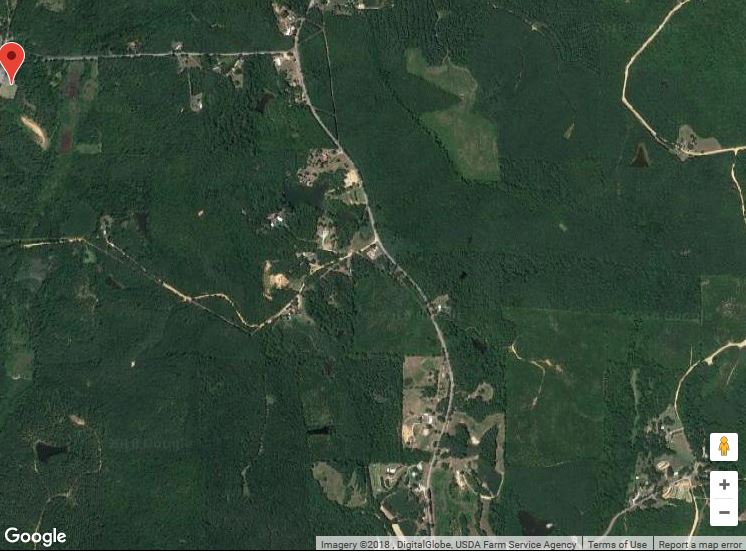
But this was what I was told happened that night in Kemper County: As the music continued in the dark church, the Alawine group froze in their tracks. The women in the bunch whispered that it was time to get out of there. The young men, being young men, threatened to go and explore, go open that door and see who was in there, or who wasn’t, find out what was going on, or not. The girls begged them not to. The minutes passed, and the girls won out. (In the map below, Antioch is the red marker at the left. Alawine Springs is the little white dot on the road on the right side of the map, just above the yellow guy.)

I’m sure the boys were bluffing as they continued homeward: They’d CERTAINLY have gone in, if those silly girls hadn’t kept them from doing it. So their pride was saved, and the girls’ fear (and the boys’!) was soothed.

Now, let me say this up front: I don’t believe in “ghosts” per se. I’m not sure my daddy did, either; he certainly added that probably somebody was in the church just trying to scare them. (Yeah…a good pianist…in the dark…) I do believe there are many things we don’t understand completely. I myself have sometimes had disturbing flashes—pictures, or something like a second or two of a film clip—of things that haven’t happened, and usually within less than 24 hours, I read about them on the Internet. This happens so much that my daughters have sometimes asked me if I knew about THAT one before it occurred. Alas, I don’t have a choice about which things I “see”—and I don’t appear able to turn the film clips “on” at convenient times. I’d just as soon not have this “ability.”

But Daddy had no real explanation for that evening. The group hurried past the church and arrived home at Alawine Springs in the dark. He remembered and told me and Jack the story when he was in his late 50’s.

Whenever you get the chance, if you’re driving in that area, try to arrive at the crossroads at dusk. Squint your eyes and envision the road as dirt, and look at the graves off to your right, and imagine music tinkling out of the old white church, and think of feeling your courage draining as your spine tingles.

I’m including here a link to a great page about Antioch on Mississippi GenWeb. It has information about the old building and the graveyard. Enjoy!
Ælfwine