Saturday, December 23, 2017

Visions of Sugarplums


Some people seem to thrive on it. I do not. 

I am done. I refuse to get back out into the full-throttle chaos of packed streets and stores, where the race to find a parking space or to get the last on-sale Deep-Fry Daddy turns normally friendly shoppers into surly gladiators.

When I had no money--and I mean, NO money--I handmade my gifts to people: sweet breads I baked in coffee cans; shawls and scarves I knitted or crocheted; terrariums made from apothecary jars and filled with hardy plants. 

At one time in the not-very-distant past, that was what our ancestors did.

In the late 1800's in the Rio community just over the Kemper County line, there was a thriving business that drew customers from miles around: Calvert's Store. Ancestors of ours patronized the place on a regular basis. 

A few years back I had the privilege of going through one of the extant ledgers kept by the store owners so long ago. Hollis Calvert, one of the descendants of the original proprietors, let me borrow it overnight and copy it. It's an artifact that I've always treasured. Even now, some people, whether they were from the area or not--in fact, whether they're from the SOUTH or not!--pore over it for hours.

This particular book had over 600 pages detailing transactions between the summer of 1885 and the early spring of 1887. Each family had a number assigned to it, so there was another list somewhere with that information as well. A clerk could look up a family's account number and record whatever items were being bought (probably on credit) that day.

And bear in mind that this is only ONE book, and the store was in operation for many decades!

I thought some of you might like to see what people did right before December 25th back in the 1880's. You may or may not see ancestors of yours in these few pages. (By the way, there weren't any Alawines living in that part of Kemper County then, so that name won't appear. But do look for R.G. Skinner.) 

Think for a while what these people's "celebrations" were, and--like me--have the good grace to be a little embarrassed at your shopping excesses.


Merry Christmas!


Thursday, December 21, 2017

The Carpenters

Before I tell you all anything new, let me take care of something old:

In my last post I wrote that Lucretia Wells Alawine died on April 29, but I find in my notebooks that her tombstone says "April 19." Also, records from Antioch Baptist Church say that was her birthdate. I don't know why my oldest records show it as the 29th, but I'm making that correction. (I'm also changing it in the original post.)

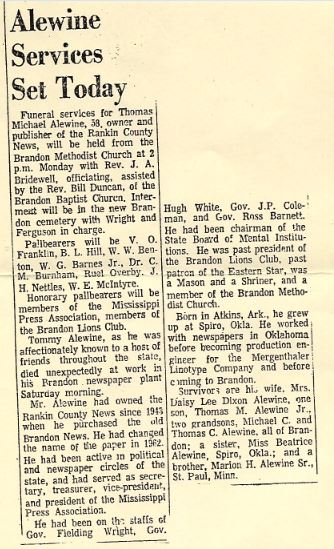
I ended my last entry with a letter from Tommy Alewine, written in 1970, and his obituary. You notice that in the letter there are many references to Alewines and Alawines. Tommy commented that "our" branch (that is, the one descended from Elijah-William R.-Andrew J.) is the only one he ever found with the "Alawine" spelling. Elijah only signed papers with an "X", so if he was illiterate, maybe that's when the spelling change happened. Who knows.

I had originally been fascinated with just that branch of my family tree--that is, ancestors who bore my last name. It was, after all, the name I had from birth. In school I was usually given one of the first seats in the row because of my name! It made me feel special. It's an interesting name, unusual, even, and you may rest assured that any Alewine/Alawine you find is related somehow, even if very distantly.

But, as I got older, the other lines also eventually drew my attention. We inherit just as many genes from them as we do from the people who gave us our own last names, and some of their stories are just as riveting as the Alewines' history.

Take, for example, the Skinners.
To refresh your memory, Samuel Thomas (my grandfather) was married to Maggie Evalina Skinner, the daughter of Madora Ann Mayo and Roland Greenberry Skinner. Roland, who went by the nickname "Roe," was the son of William D. Skinner and Susan Kelly. 

William (or "Bill") Skinner was a carpenter. In the 1850 census the tabulator in Clarke County, Mississippi, indicated that Bill was 18 and living with his father Howard. He was described as a "farmer."
Copy of marriage bond, William Skinner and Susan Kelly
But by 1870 his occupation was given as "House carpenter," and he was living in Lauderdale County with his family: Susan Ann Kelly, 35 ("Keeping house"); Roland G., 14; Malinda J., 11; William A., 9; Calvin R., 7; and Susan A., 3.

Something fun to know is that those initials after the sons' first names ("G.," "A.," and "R.") stand, respectively, for Greenberry, Ashberry and Rasberry. People today sometimes give all their children names starting with the same letter--Kayla, Kim, Kamden, and so on. I guess back "in the day" they did a similar thing.

Like most of our male ancestors here in the South, Bill served in the Confederate Army during the Civil War. Records show that, after the siege and surrender of Vicksburg, he signed an oath, stating he would not "take up arms again against the United States, nor serve in any military, police or constabulary force...against the United States of America."
Loyalty oath signed by W.D. Skinner
This was a document required of Confederate soldiers at the time, and, having signed it, most immediately found another unit to join (or went back to the same one) and continued to fight. Perhaps Bill did, or perhaps not. His brother Calvin J. had apparently died or been killed earlier that year (or possibly in 1862); their father Howard litigated to collect the salary owed him and was paid $127. 
Transcription of document below

I'm including these photos of microfilm copies I made, mainly to show two things:

First, I believe the Vicksburg loyalty oath WAS signed by Bill Skinner himself. That's a kind of neat thing for a descendant to have.

Second, the document above, in which Howard Skinner appointed John P. McRee of Clarke County to act as attorney on his behalf in collecting the back salary Calvin had earned (but not been paid), may have at least been signed, if not completely written, by Howard Skinner. Again, seeing one's great-great-great-grandfather's handwriting is a real trip!

By 1880, Bill Skinner was in Kemper County, and Susan Kelly had died. He was married to Maggie Petty Mayo Sweeney, and they had one child, Jesse, together. Their household was possibly not unusual for the time: Bill's daughter Susan was there, and also Maggie's sons "Eddie" (Edward) and Elijah Mayo, and her daughter "Mike Swinney" (who was listed as a boy here, and whose name was actually Mica, after her father who'd died), and the youngest, Jesse. Jesse's shown as being 5 years old, so apparently Susan Kelly died between 1870 and 1874 or so.

Bill's occupation in 1880 is listed as "Mechanic in wood shop." I suspect that phrase may indicate he possessed more than the usual skill in carpentry. A story passed down to my father by his mother and his grandmother Madora says Bill was heavily involved with the construction of the First Baptist Church in Meridian, Mississippi. I've looked at what records I can find online and haven't yet seen anything listing the carpenters who built First Baptist, which isn't standing anymore. There are possibly church records I don't have access to, if anyone wants to find out. And, if you do, please let me know!

Over in Neshoba County in 1880 you see R. G. Skinner (that would be "Roe") and M. A., his wife (Madora Ann Mayo, "housekeep") with two children, both male. Roe is listed as "Carpenter." 
Roe and Madora Skinner
He was obviously talented and probably built a number of structures that aren't around anymore; but two that ARE still standing are the Zion Baptist Church and a private dwelling on Zion Road halfway up King Hill.

(Built about 1880 or 1885)

In 2002 I wrote the documentation to list Zion Baptist Church in the National Register of Historic Places, so I'm including a few paragraphs from the "Description" section to show what makes the church unique, from a historical point of view. 
Interior of Zion Baptist Church
My friend Richard Cawthon, historian at the Mississippi Department of Archives and History, passed the nomination proposal to me without knowing at first that my great-grandfather had built the church. THAT was what made it unique to ME!

The church minutes indicate that it was built in 1910-11.

A final interesting thing--again, from a personal perspective--is something my mother told me a year or so after my father died.

I lived near Memphis at that time, and she was visiting. We started talking about family things, old stories, and, of course, with Daddy gone, we talked about him and his family a good deal. 

Mother reminisced about how Daddy's mother had been building a chicken coop at their farm one time when....

I had a "Wait, what?" moment (to put it the way we do today). She gave me an amused look: Didn't Daddy ever tell me that his mother, Maggie E. Skinner Alawine, always did the building projects?

Um, no...he'd never mentioned that. Mother went on: His father, Samuel Thomas Alawine, couldn't build anything much, she said. But his mother had SKILLS. She basically took charge of the construction of the outbuildings and so on. Sam let her do it, because--using Mother's own words that day--he "couldn't hammer a nail straight."

However, Maggie's father AND grandfather had both been master carpenters. She had to have picked that ability up from a longstanding family tradition of woodworking--even as a girl, in an age when women's occupations were listed as "housekeeper" on the censuses. (See above!)

I was more or less quietly astonished for a few minutes. Then I asked Mother, "Wonder why Daddy never mentioned that?"

What she answered was what women hear even now, sometimes: He wasn't sure how HE felt about his mother's, and not his father's, being the builder of the family. It went against all the societal norms of the time!

Warning: I am NOT implying that Daddy either had a problem with it or that he didn't respect his father--quite to the contrary. He was awed by Maggie's abilities, as who wouldn't be. But in a day when women didn't work in nontraditional gender roles, Maggie (and, who knows, maybe her sisters?) possibly was unusual. Gives me even more reason to admire her.


Ælfwine


Saturday, December 16, 2017

The First Family


"I want to warn you that this 'business' is just as narcotic and habit-forming as any drugs you might get hold of! And it has as many dead-ends..." —Thomas M. Alewine, 1970

[This entry has a correction: Lucretia Wells died on April 19, not the 29th.]

I'm going to start with two requests:

First, PLEASE share this website with cousins. In the material I've posted so far, I've intended to whet interest and provoke comments. Are there family lines or connections you'd like to see traced out? Let me know in my comment bar.

Second (and this relates to the first), these are my family notebooks and records.
This doesn't include computer records or the four office-type storage boxes. I'd like for everybody to have copies of what they're interested in, but it might be impossible. The best I can do is show the bare-bones outlines and tell a few stories.

Thank goodness for the Internet.

Now, to another of those stories:

In the mid- and late-1960's my mother was working at the hospital, and life for me and Jack in the evenings was quiet, for a while. After supper and before Daddy left to pick Mother up after her shift (she didn't drive), he might watch TV or read, but from time to time he'd start talking about things he remembered about his grandparents and other relatives. I was a younger teen at that time and just beginning to be interested in family history.
This was when I heard about Andrew Jackson Alawine's first family.

Andrew and Lucretia, as I mentioned before, died in 1922--she on April 19 (which her tombstone at Antioch Baptist Church says was also her birthday), and he on May 20. Lucretia's year of birth varies in records, but the 1850 and 1860 censuses both show her having been born in 1838, so let's go with that. I'm pretty sure she was several years older than Andrew, anyway. She was 84 at her death.


This photo (in my last post) was most likely taken during the 1910's, sometime...perhaps no more than two or three years before she died.
 
Daddy was born in 1912. He remembered his grandparents quite well. He lived right down the road from them. In the 1980's he drew a sketch of the floor plan and surrounding area of the house he grew up in, and of Andrew Jackson Alawine's house. I took his rough sketch and redid it with darker ink to make it clearer. I put the two houses in spacial context, and I'm including both drawings here so those of you unfamiliar with that part of Kemper County, Mississippi, can have an idea of where the families lived.
 
Daddy was almost 10 years old, then, when Lucretia died. He recalled clearly the events of her death. He said that, afterwards, his grandfather "kind of went crazy a little." Andrew couldn't seem to sleep, didn't want to eat, talked about long-past things as if they were current events, and even once or twice relived parts of the Civil War.

(He did serve in the Civil War. According to Daddy, Andrew never would talk about it much, or at least never did with him. I've read that many veterans of different wars don't like retelling their experiences. I doubt I'd want to, either.)

As I listened to this sad story, he added, "It was almost as if his will to live just died, too, when she died."

If so, maybe the first family he lost, his experiences in the war, the loss of his daughter Rena in the 1870's, and at last the death of Lucretia now HAD all finally taken the ultimate toll on him. He lived about a month after Lucretia died, you notice, though he was perhaps seven years younger than she'd been, and apparently in fairly decent health.

Now, about that first family:

Some time or other, Daddy told me that Andrew Jackson Alawine had had a small family before he and Lucretia Wells married. Daddy couldn't remember all the details. His own parents (my grandparents) were gone, and it had been almost 50 years since that spring of 1922 when his grandparents had died. He THOUGHT the first family had included a wife and child; he THOUGHT maybe they'd been killed during the siege at Vicksburg, or maybe escaping in a boat or on a raft.

Like a couple of other stories he told me, that one I kept kind of filed in the back of my mind. I've learned not to completely discount family legends. Many times there's some amount of truth in them. But I'd never heard that particular one from anybody else, and years passed before I mentioned it to Alton.

This blog will inevitably have many references to Alton because, as I've said, he and I worked pretty closely on family research for a good while. And I've also pointed out that, in the same way that Daddy was able to recall his grandparents and remember things about them (though they were born some 177 years ago!), Alton's mother was able to fill in many gaps--because she was their daughter-in-law! She herself lived to her mid-90's and had a pretty clear memory for many years.


As he put it in one of the early letters to me:
(By the way, the reference here to "Elisha" actually was meant to be "Elijah." At that point, neither Alton nor I was sure whether Elisha Alewine and Elijah Alewine were the same or different men, as the names appear in records both ways. Later, I found proof that they were two people, and that our ancestor was Elijah.)

So sometime in late 1976 Alton asked her about this earlier family, and here are the details she gave him:
So, one legend, proved to have truth in it.

Genealogical research, as I learned early in life, can be extremely addictive. Back in 1970, I got in touch with Thomas "Tommy" M. Alewine, editor and publisher of the Rankin County News. I really don't remember now how I knew to contact him, but I did. I was a youngster then, but Daddy's stories had really got me obsessed with finding out more about my ancestors, and I'd somehow heard about this newspaper man who might have records.

He was very kind and answered my first note briefly, but also sent me a copy of Andrew Jackson Alawine's Civil War record as an introductory thing to pique my interest further. I answered that letter, and then, on August 2, he mailed this to me:

 
This letter is extremely significant and harks back to the first request I made in this post, about sharing the blog around. Because, within a week after I got that letter, he had died unexpectedly, at the age of 58.

If he hadn't shared the information he did, in that letter, I might have gone many many years without having a good starting point. Short though it may be, it is full of names and references that I was able to expand on; and, later, Alton used the information and did still more research.

I indulged in a crying fit that lasted some time when my parents called to tell me Tommy had died. I was visiting my sister Carol in Mobile; I may even have taken that letter with me, because I was so excited. I was so looking forward to a lengthy acquaintance with the newspaper man, exchanging interesting facts and stories about the family.

We have so much more access to information now than I did at that time, though sometimes lately it seems to be threatened by what looks increasingly to me like governmental and corporate censorship. (I refer to the recent nullification of Internet neutrality.)

So for now, feel free to share, to promote, to save whatever papers and documents I post.

If it hadn't been for Tommy Alewine and his letter to me a week before he died, you might not have so much of it now.


 Ælfwine